

Customer Experience as a Transformation: Christos Patikas' Journey at AEGEAN
Customer Experience as a Transformation: Christos Patikas' Journey at AEGEAN
For many organisations, Customer Experience starts with a new department, a Voice of Customer programme or a journey mapping initiative. For Christos Patikas, Head of Customer Experience at AEGEAN, those were important building blocks—but they weren't the real transformation. Looking back on the past four years, he believes the biggest lesson is that Customer Experience isn't simply about improving the customer journey. It's about changing the way an organisation works.
"If I had to do it again," Christos reflects, "I would put much more emphasis on the fact that this isn't simply about creating a department that acts as the voice of the customer. It's about changing the way you create and improve products and services, so they align more closely with how customers actually experience them."
Who is Christos Patikas?
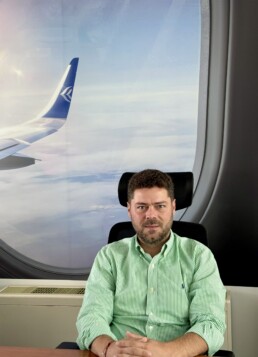
Christos has worked at AEGEAN for over twelve years, but his career didn't start in Customer Experience. He began on the frontline as a ticketing clerk before moving into data analytics for ground operations, call centre transformation and, eventually, leading the airline's Customer Experience function. His background in Physics and Sustainable Tourism Development may not seem like the obvious route into CX, but throughout his career he found himself fascinated by how organisations solve problems—and why customers often experience those same problems so differently.
His interest in Customer Experience really began during a call centre transformation. While departments were solving issues within their own areas, customers simply experienced one journey. "Companies create products and resolve issues in a very siloed way," he explains. "At the same time, customers consume products and services as a journey." That insight convinced him that Customer Experience wasn't simply another discipline; it offered a different way of improving the business.
Understanding the brand: AEGEAN
Founded in 1999, AEGEAN has grown into Greece's largest airline, transporting around sixteen million passengers every year. Throughout that growth, one philosophy has remained central: politismos.
Much like the Danish hygge or the Japanese omotenashi, politismos cannot be captured in a single English word. It reflects a way of thinking that combines hospitality, care, respect, culture and genuine human connection. For AEGEAN, politismos is more than a value—it shapes the experience they strive to create for every passenger. Every interaction is an opportunity to reflect the warmth, attentiveness and generosity that are deeply rooted in Greek hospitality.
According to Christos, customer centricity itself was never the challenge. "The challenge isn't whether you're customer-centric. The challenge is how you apply the mechanics of customer centricity." As the airline expanded, delivering one consistent experience became increasingly complex. More partners, more operational teams and more stakeholders all contributed to the customer journey, making coordination just as important as intention.
The challenge: Looking beyond the organisational chart
When AEGEAN established its Customer Experience department in 2022, the team was built around two pillars. The first focused on Customer Insights: creating what Christos describes as a "central nervous system" that continuously listens to customer signals. The second focused on improving customer journeys by coordinating change across departmental boundaries.
Although the ambition was clear, Christos soon realised that implementing Customer Experience was far more challenging than introducing new tools or processes.
"Customer Experience is usually seen as something fluffy—something that's nice to have," he says. "In reality, it's one of the hardest transformation initiatives you can undertake."
The reason, he explains, is that Customer Experience asks people to work within a different framework. Instead of optimising their own department, they are asked to collaborate around the customer's journey. "I'm not saying Customer Experience invented cooperation," he says. "The difference is the framework. The framework becomes the customer journey."
Looking back, this is the one thing he would communicate much more clearly if he had the opportunity to start again. Organisations often believe they are introducing a Customer Experience function, while in reality they are embarking on an organisational transformation.
The solution: Demonstrating a different way of working
Rather than trying to convince colleagues through presentations or business cases, Christos and his team chose to lead by example. They started with two journey mapping projects that brought together colleagues from different parts of the organisation to analyse complete customer journeys.
"The journey mapping itself was just the tool," Christos explains. "What really mattered was bringing everyone together."
For the first time, customer emotions, operational processes, actions and pain points were discussed in one room. Those conversations generated better ideas, but perhaps more importantly, they showed people a different way of working. Participants experienced what it meant to approach problems from an outside-in perspective rather than an inside-out one, and many became Customer Experience ambassadors within their own departments.
The workshops also revealed something else. Many customer frustrations didn't belong to one department at all—they existed in the spaces between departments. That insight became the catalyst for improving communication, collaboration and, ultimately, the way ownership was organised.
Creating accountability at the journey level
One of the most important changes that followed was redefining accountability.
“The customer doesn’t experience the transfer desk,” Christos explains. “They experience getting connected seamlessly through the airport.”
Traditional organisations assign ownership to individual touchpoints. Customers experience the complete journey. As a result, AEGEAN introduced accountability at the journey level, ensuring someone was responsible for coordinating improvements across multiple departments rather than within a single operational area.
This thinking eventually influenced the organisational structure itself. Teams responsible for products, services and service recovery were brought closer together, making it easier to improve experiences across the entire journey instead of optimising isolated parts.
Building trust in customer insights
Alongside journey improvements, AEGEAN invested heavily in its Voice of Customer programme. Although the airline had measured NPS for years, customer feedback only became truly influential once people trusted the insights.
For Christos, that trust came from two decisions. First, customer feedback was combined with operational data, making it easier to understand why customer scores changed. Second, the organisation itself helped design the programme.
“We’re not going to build dashboards based only on what we think is important,” he recalls telling colleagues. “Come and help us define the questions according to your needs as well.”
By involving stakeholders in designing both the surveys and the reporting, they became co-creators rather than recipients. Customer verbatims were presented alongside dashboards and KPIs, helping teams connect the numbers with real customer experiences. Over time, customer feedback became part of everyday operational conversations rather than something discussed only within the Customer Experience team.
Lessons learned & advice for CX professionals
After four years, Christos is most proud that Customer Experience has become part of everyday conversations across AEGEAN. “If the journey stopped today,” he says, “I would already be very proud that this organisation has started working from an outside-in perspective.”
Looking back, there are a few lessons he would share with other CX professionals embarking on a similar journey.
First, recognise from the beginning that Customer Experience is an organisational transformation. Building a department is only a small part of the challenge. The real work lies in changing how people collaborate, make decisions and improve products and services together.
Second, invest equally in customer insights and action. A successful Customer Experience function needs people who can turn customer signals into actionable insights, but it also needs clear ownership of customer journeys. Without both, Customer Experience risks becoming a reporting function rather than a driver of change.
Finally, always communicate Customer Experience in the language your organisation understands. Whether that means demonstrating operational improvements, financial impact or customer outcomes depends entirely on the culture of the organisation. There is no blueprint that works everywhere.
Perhaps Christos’ simplest advice comes from the philosophy that now guides his own work. “Try to apply an outside-in filter to everything you do,” he says. “Ask yourself whether what you’re doing serves the customer or serves the organisation.” That doesn’t mean every decision should favour the customer over the business, but it does ensure every decision is made consciously rather than by default.
Final thoughts
Christos' journey at AEGEAN shows that Customer Experience is about much more than introducing journey maps, dashboards or Voice of Customer programmes. Those are important tools, but they are only valuable if they help organisations change the way they work together.
For Christos, that is ultimately what Customer Experience has become: a different framework for making decisions, organising ownership and improving experiences. And perhaps that's the biggest measure of success—not that a Customer Experience department exists, but that the organisation increasingly looks at itself through the eyes of its customers.